
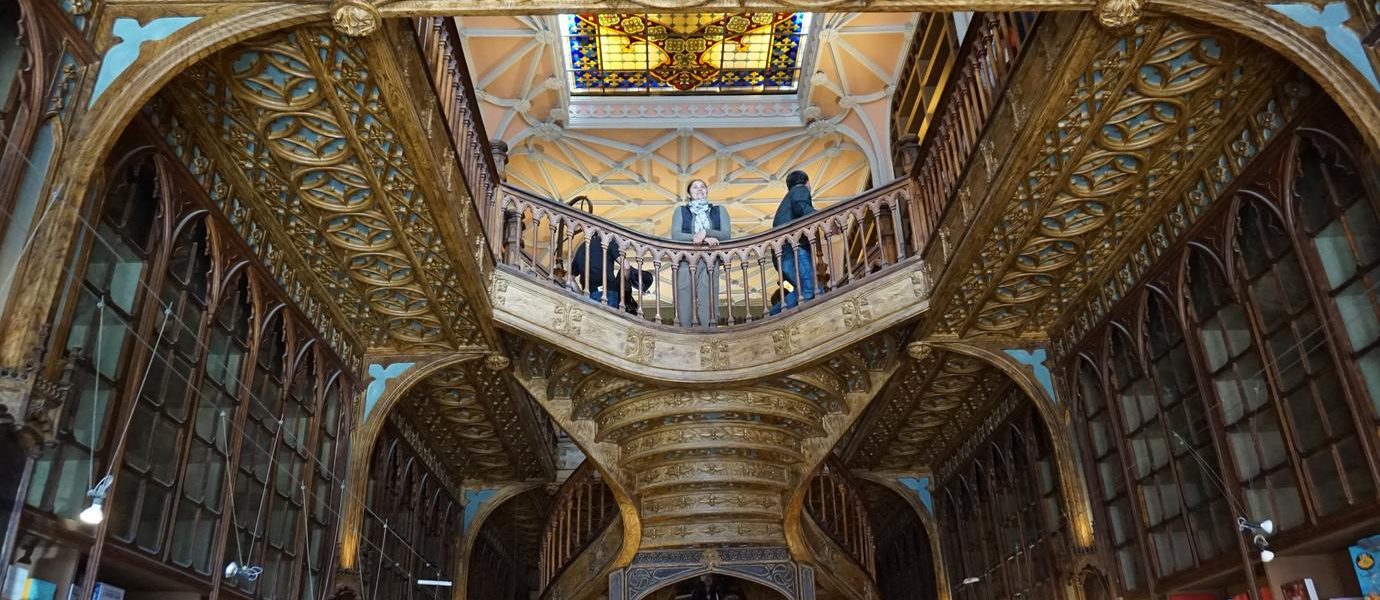
Portugal’s most remarkable bookshops, from a world record to a flying bicycle
One of these bookshops holds an actual Guinness World Record. Another is routinely mistaken for the inspiration behind Hogwarts, a claim its own supposed muse has publicly denied. A third operates out of a former printing press with a mechanical bicycle suspended from the ceiling. Portugal’s bookshops are not a footnote to a trip; several of them are destinations in their own right.
This guide covers ten of the country’s most distinctive bookshops, spread across six towns. Four are the classics: Bertrand in Lisbon, Lello in Porto, Almedina in Coimbra, and Ler Devagar at LX Factory. The other six, in Óbidos, Braga, Cascais and Porto again, rarely make the cut. Between them, they trace a loose Lisbon-Coimbra-Porto-Óbidos-Braga-Cascais route. It happens to cover a fair share of Portugal’s classic road trip, regardless of how you feel about books.
Why a private chauffeur makes sense for a bookshop route
Ten stops across six towns is not a single afternoon. Most visitors will realistically pick a handful rather than all of them. A few practical notes for anyone building this into a trip:
- Lisbon, Coimbra and Porto sit along the same north-south route, so all three can be folded into one longer drive instead of three separate trips.
- Livraria Lello limits entry with a timed ticket and draws long queues in high season, so arriving at the right time matters more than it looks like it should.
- Ler Devagar sits inside LX Factory, a former industrial complex on the western edge of Lisbon that is easier to reach by car than by the metro.
- Óbidos, Braga and Cascais each sit on routes Amiroad already covers, so a bookshop stop can be added to an existing day trip rather than planned as its own excursion.
Livraria Bertrand, Chiado: the world’s oldest working bookshop
Livraria Bertrand opened in 1732. The 1755 earthquake forced it to move. It reopened in 1773 on Rua Garrett in Chiado, where it has traded ever since. In 2011, Guinness World Records certified it as the oldest bookshop in the world still in operation. The shop now displays that title proudly near its entrance.
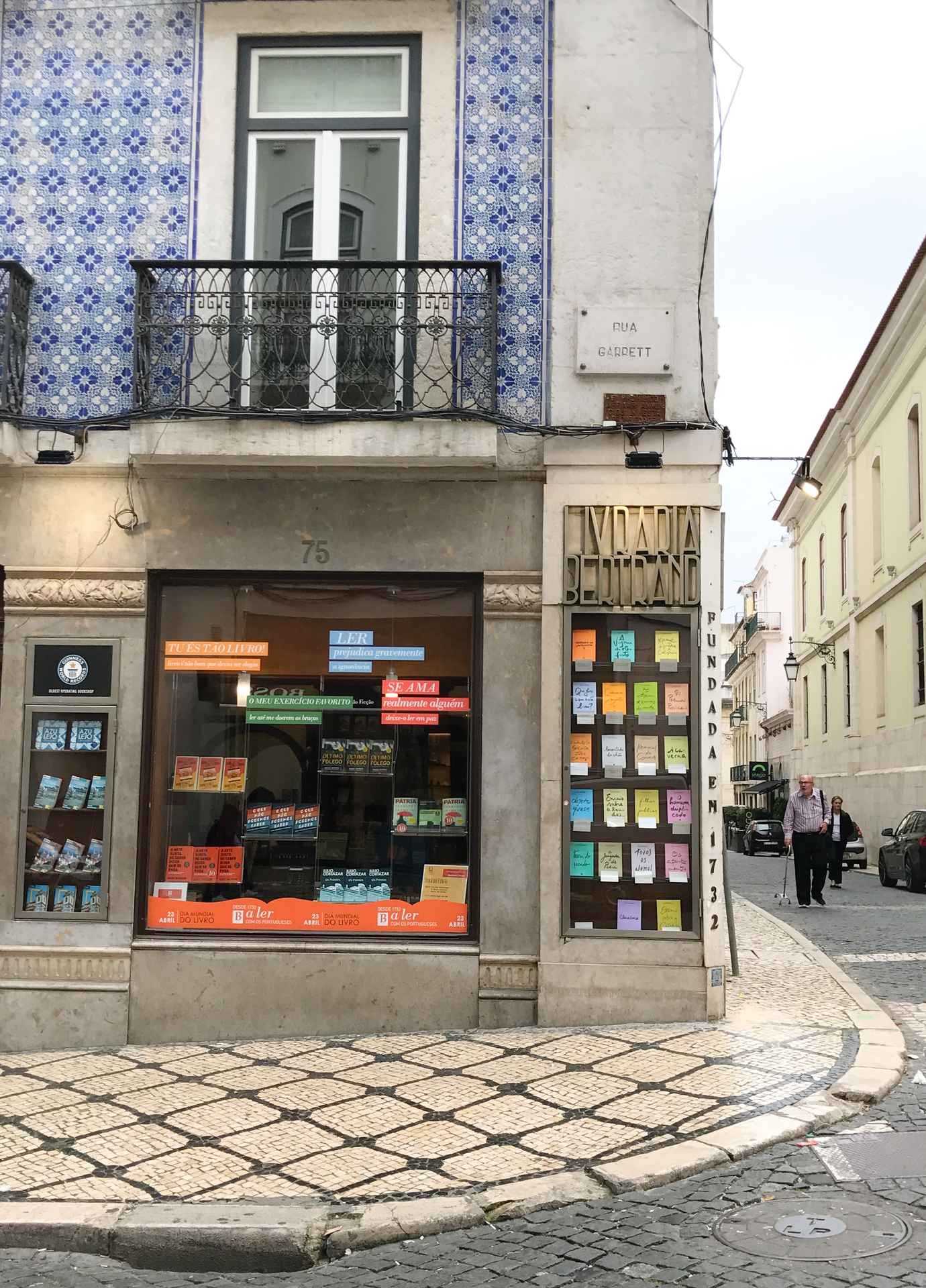
The rooms behind that facade are lined with azulejo tiles and connect one into the next. That layout shaped the shop’s other role in Portuguese history. For much of the 18th and 19th centuries, it worked as a literary tertúlia, a gathering spot for writers. Alexandre Herculano and Ramalho Ortigão were among those who debated ideas here, over the same shelves that still stand today.
Livraria Lello, Porto: the staircase, and the myth that won’t die
Livraria Lello traces its roots to 1881. The building most visitors recognize today opened in 1906, designed by Francisco Xavier Esteves in neo-Gothic and Art Nouveau style. It was the first structure in Porto built with reinforced concrete, though none of that shows. Carved wood, stained glass and a crimson staircase curve through the middle of the room, beneath a stained-glass skylight.
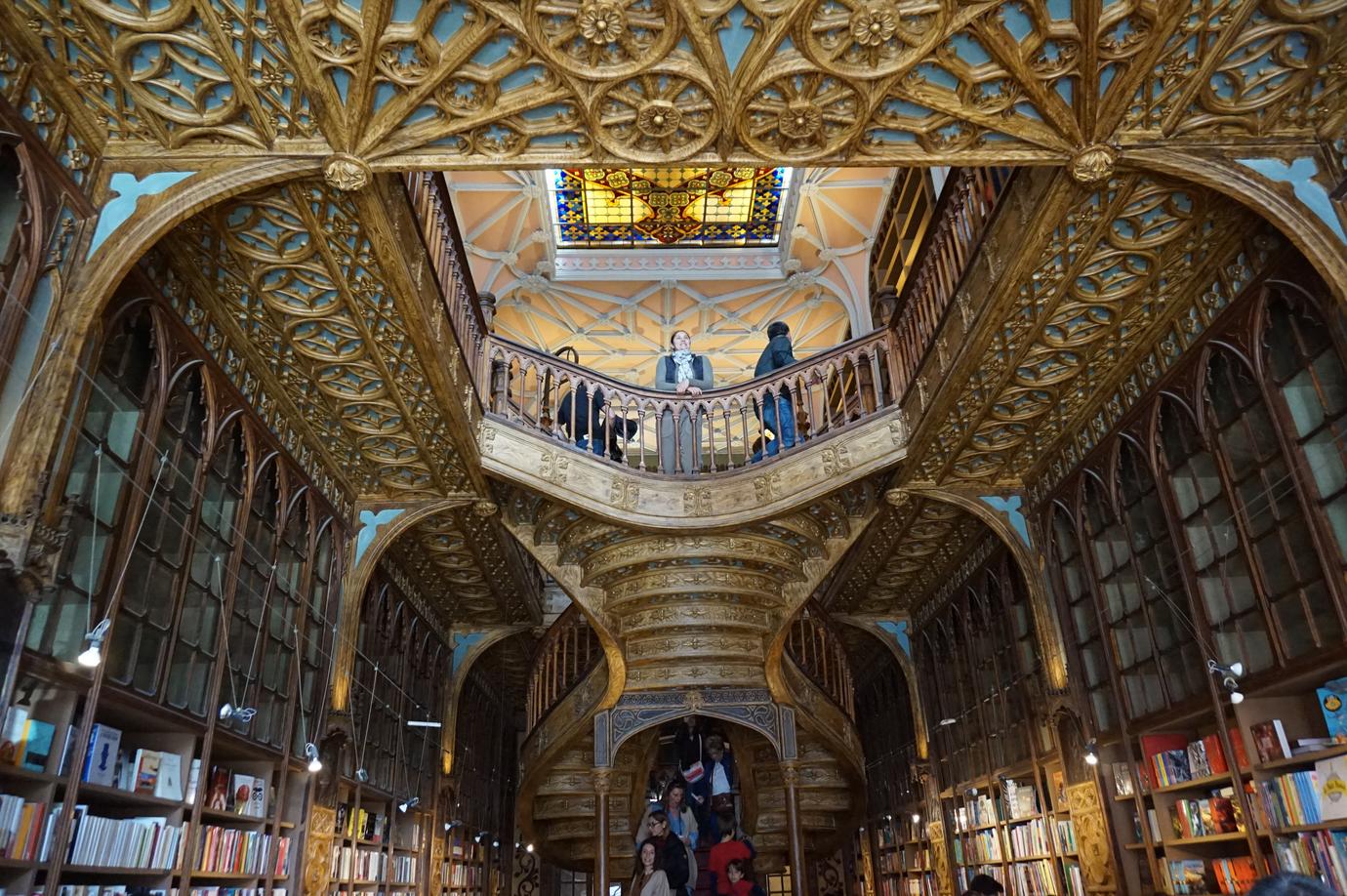
The bookshop is often billed as the inspiration behind Hogwarts’ library. The theory goes that J.K. Rowling visited while teaching English in Porto in the early 1990s. Rowling herself has denied it directly. In 2020, she stated on social media that she never visited the store and only learned of its existence later. The myth persists anyway. Lello genuinely looks like it belongs in a novel, wizarding backstory or not.
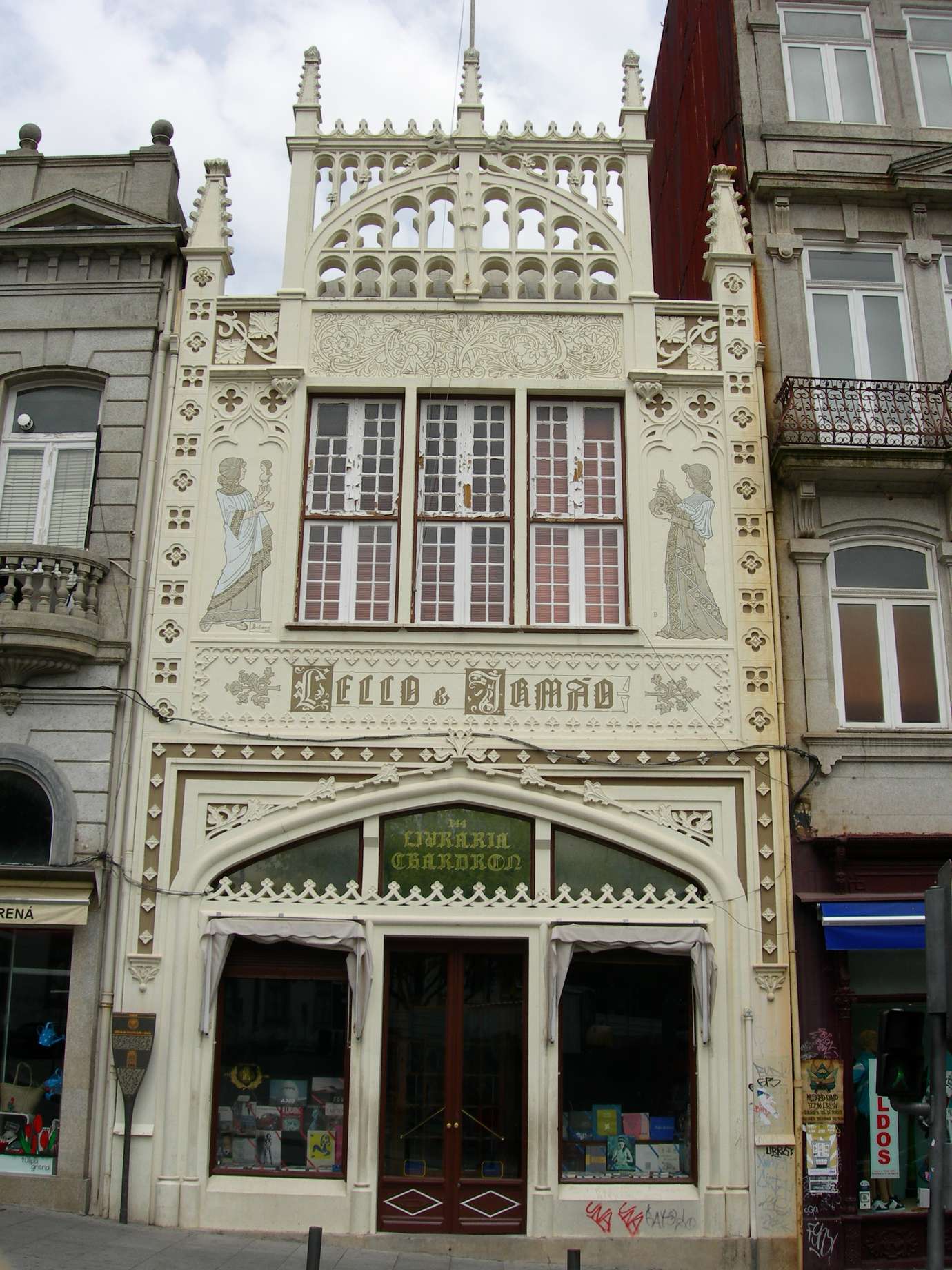
A timed entry ticket, booked through Lello’s own website, is required, and the fee is deducted from any book purchase inside. It is worth knowing before arriving expecting to simply walk in. For more on the city, our guide to things to do in Porto covers what else pairs well with this visit.
Livraria Almedina, Coimbra: a bookshop at the city gate
Livraria Almedina opened in 1955, founded by Joaquim Machado at the foot of the Arco de Almedina. This medieval gate once marked the main entrance through Coimbra’s city walls. The setting was no accident. Coimbra has been a university town since 1290. A bookshop planted at the gate to its old center was always going to find an audience among students and academics.
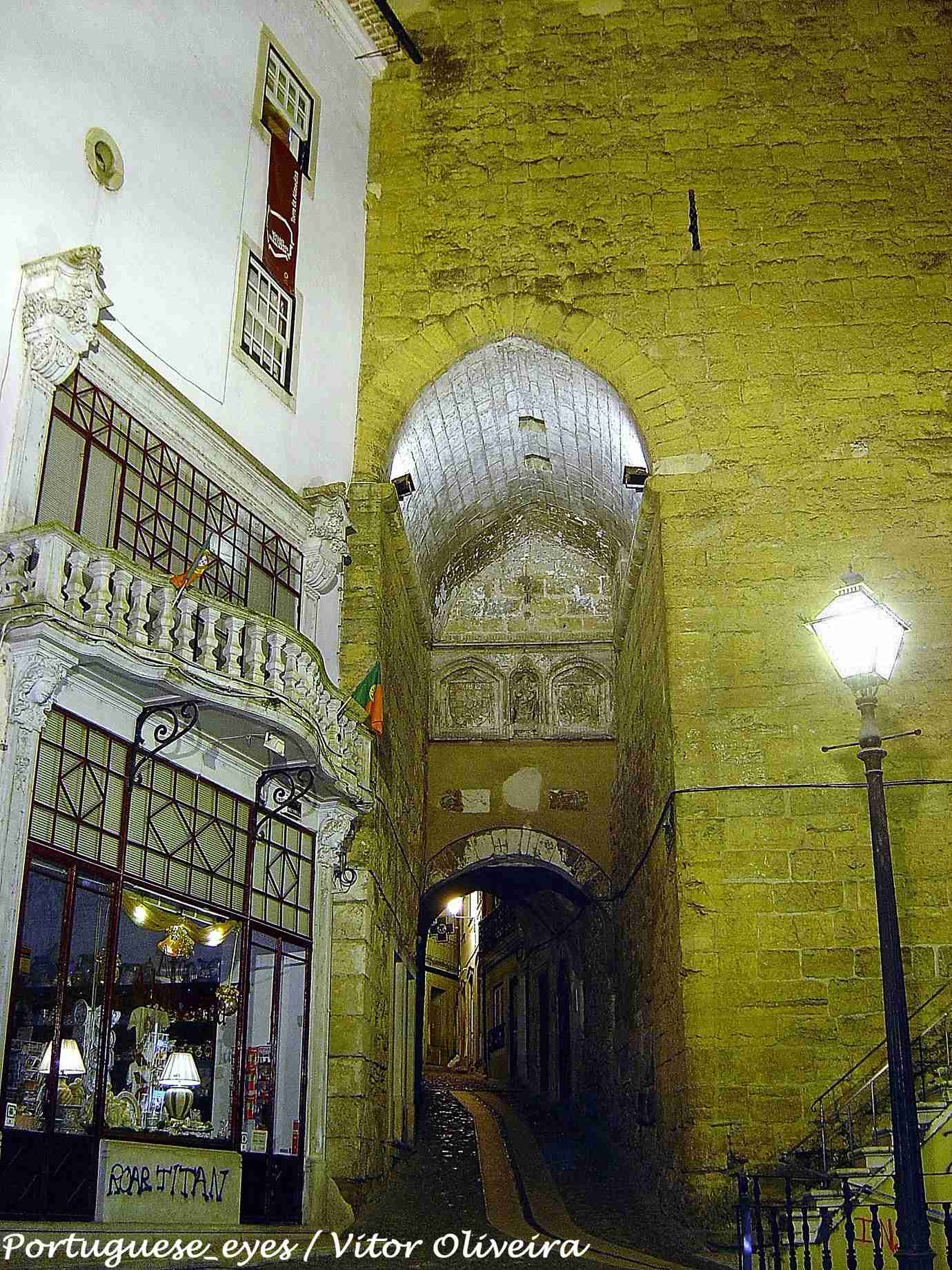
That single shop eventually grew into Grupo Almedina, now one of Portugal’s most important academic and legal publishing houses. It is still headquartered in the same city where it started. The original store under the arch remains open today. It might be the most understated of the four bookshops covered here, despite having arguably the most interesting backstory.
Ler Devagar, Lisbon: the indie alternative worth the detour
Not every remarkable bookshop in Portugal is centuries old. Ler Devagar, meaning “read slowly,” occupies a former 19th-century printing press inside LX Factory. LX Factory is a converted industrial complex on the western edge of Lisbon. Iron mezzanines wrap around a cavernous main hall stacked with more than 50,000 volumes. A mechanical flying bicycle by Italian artist Pietro Proserpio hangs suspended above the main floor, built from recycled machine parts.
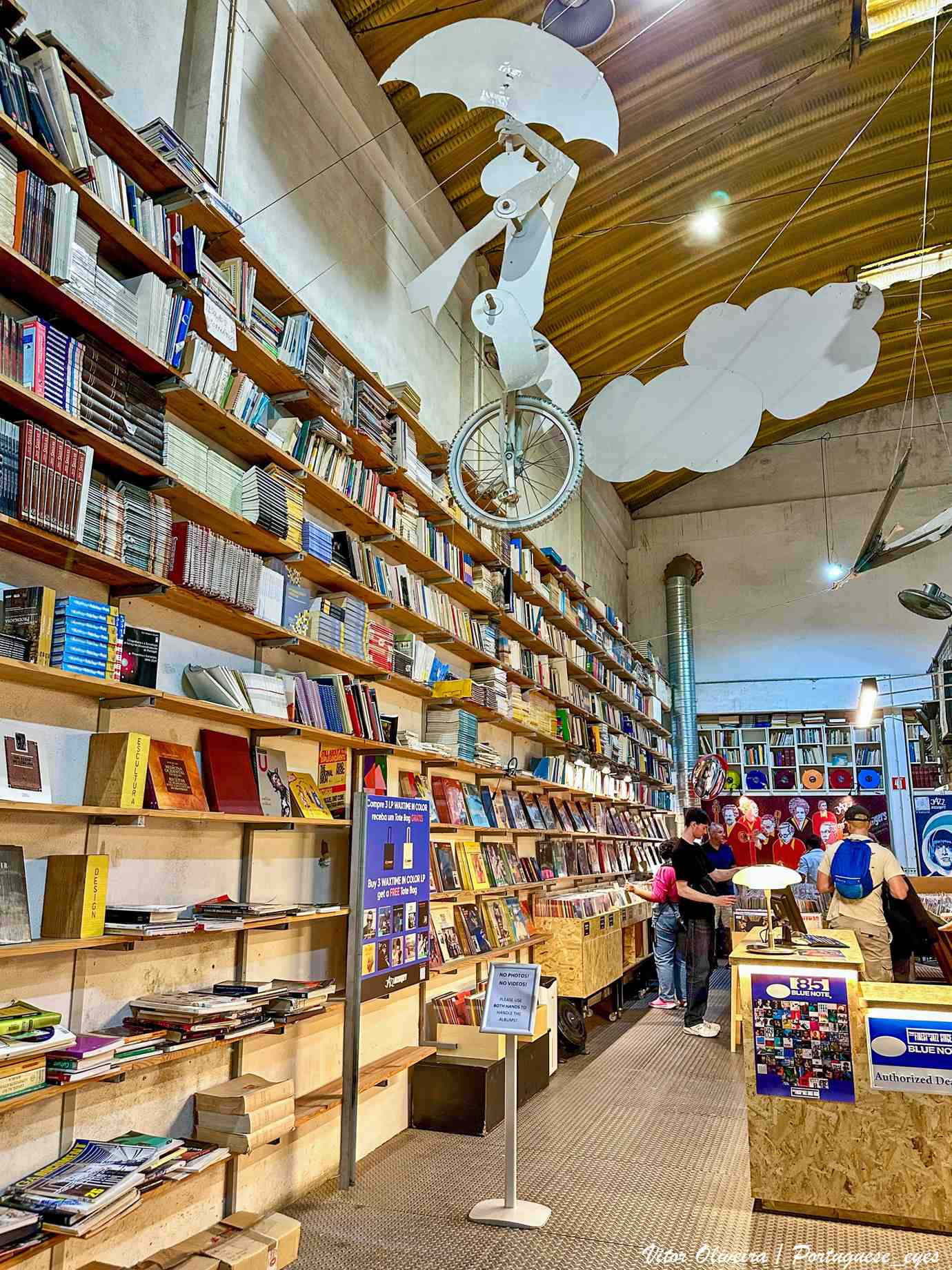
It has none of the queues that come with Lello’s fame. Beber Devagar, the attached café and bar, makes it easy to lose an afternoon here instead of rushing through for a photo. For more of this side of the city, our guide to hidden gems in Lisbon covers other spots in the same spirit.
Beyond the four icons: six more that most guides skip entirely
Bertrand, Lello, Almedina and Ler Devagar are the names that come up in almost every list of Portugal’s best bookshops. That is exactly why they only get you so far. The six below are spread across four more towns. Several are stranger and better than the four above, and almost none of them show up outside specialist guides.
Livraria de Santiago, Óbidos: a 12th-century church, minus the pews
The Igreja de São Tiago was built in the 12th century under King Sancho I. It was destroyed in the 1755 earthquake and rebuilt by 1772. By the late 20th century it had been deconsecrated and left standing empty. In 2011, José Pinho, the same publisher behind Ler Devagar at LX Factory, proposed turning it into a general bookshop for Óbidos. It opened as Livraria de Santiago in 2013, with the church’s original architecture left fully intact. Bookshelves now stand where the altars once did, under the same vaulted ceiling.
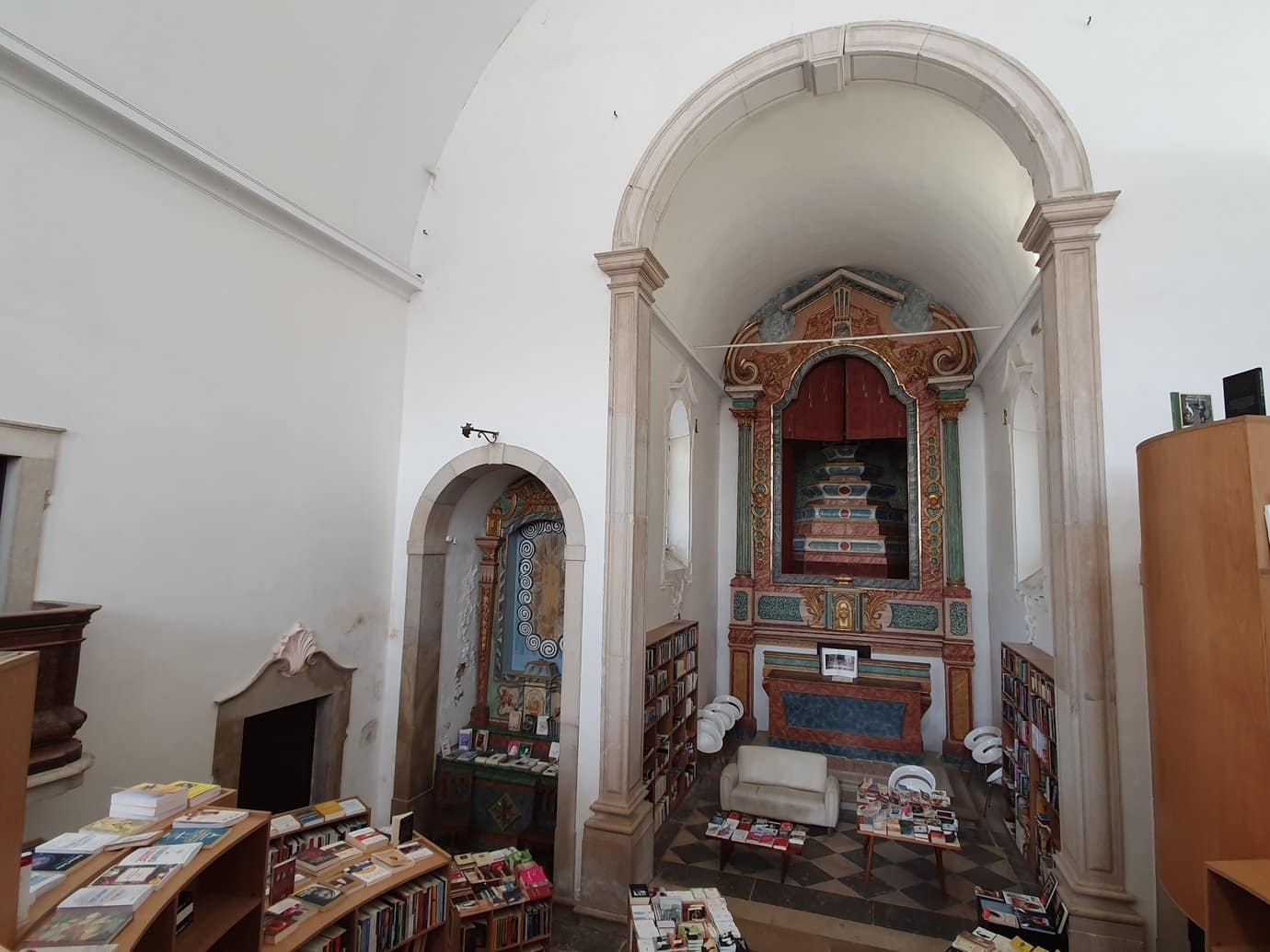
That single project grew into something larger. On 11 December 2015, Óbidos joined UNESCO’s Creative Cities Network as a City of Literature. It was only the second Portuguese location in the network at the time. The wider “Óbidos Vila Literária” project has since opened eleven themed bookshops around the walled town, including a literary hotel. All were built from the same idea: putting books into buildings that had otherwise run out of purpose. Our Óbidos day trip guide covers the rest of what the walls enclose: the castle, the ginjinha and the medieval village beyond.
Livraria do Mercado Biológico, Óbidos: books between the vegetables
Livraria de Santiago gets the attention, but a short walk away on Rua Direita, something just as unusual awaits. A former fire station houses Óbidos’s organic market, sharing its floor with a secondhand and rare bookshop. Well over a thousand reused wooden fruit crates climb the walls as shelving, stacked with used books, gastronomy titles, small-press editions and fanzines. Stalls of vegetables, fresh herbs and jam share the same room. It is an odd pairing on paper, and a genuinely pleasant one to walk through. There are none of the queues that build up outside the church down the street.
Livraria Centésima Página, Braga: a bookshop inside a Rococo mansion
Casa Rolão was built between 1758 and 1761 for the Rolão family, whose fortune came from the silk trade. It was designed by André Soares, one of the leading names of Portuguese Rococo architecture. The building has been protected as a property of public interest since 1977. It has housed Livraria Centésima Página since 2005, more than two decades after the bookshop itself first opened in 1999.
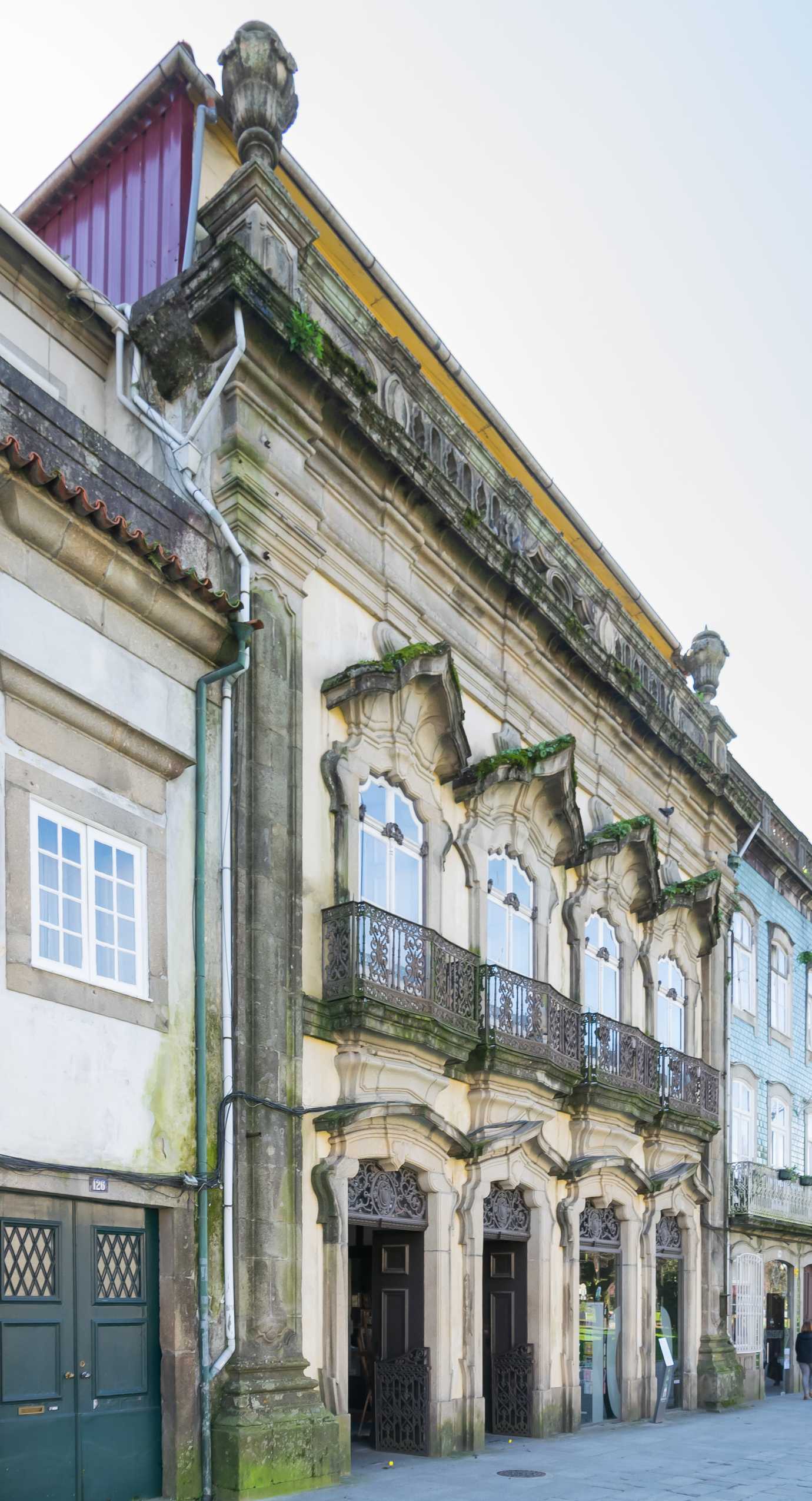
Inside, the shop shares the building with a café and a small interior garden. It regularly hosts exhibitions, book launches and workshops, making it as much a cultural venue as a place to buy books. For the rest of the city, our Braga guide covers the Bom Jesus staircase and the country’s oldest cathedral. Both are a short drive from Casa Rolão’s front door.
Déjà Lu, Cascais: a secondhand bookshop with a cause, hidden in the fortress
Déjà Lu is tucked away on the first floor of the Citadel Art District, inside the Cidadela de Cascais. We cover the fortress itself in our Cascais and Estoril guide, but this bookshop is easy to walk straight past. Founded by Francisca Prieto and Maria Faria de Carvalho, it sells secondhand books arranged in wine crates rather than by conventional genre. Photos of the space are on Déjà Lu’s own Instagram. The room feels more like a well-loved living room than a shop. Every profit goes to institutions that help people with Trisomy 21 find employment. That makes browsing here about as close to a guilt-free souvenir as a bookshop gets.
Livraria Poetria, Porto: the only bookshop in Portugal built entirely around poetry
Poetria has specialized exclusively in poetry and theatre since 2003, the only bookshop in the country to do so. It holds more than 10,000 titles, and once earned the description “gourmet bookshop” from Portuguese author Valter Hugo Mãe. In 2021 it faced eviction from its original address, which triggered public petitions and civic pressure. That pressure grew serious enough that Porto’s City Council stepped in. It leased the shop a new space on Rua de Sá de Noronha, for a symbolic rent. It reopened there in January 2022, a hundred meters from where it started.
It is a small, specific kind of survival story. It says as much about how Porto’s literary community values its bookshops as anything written on the shelves.
Livraria Chaminé da Mota, Porto: forget Lello, this is where the antiques live
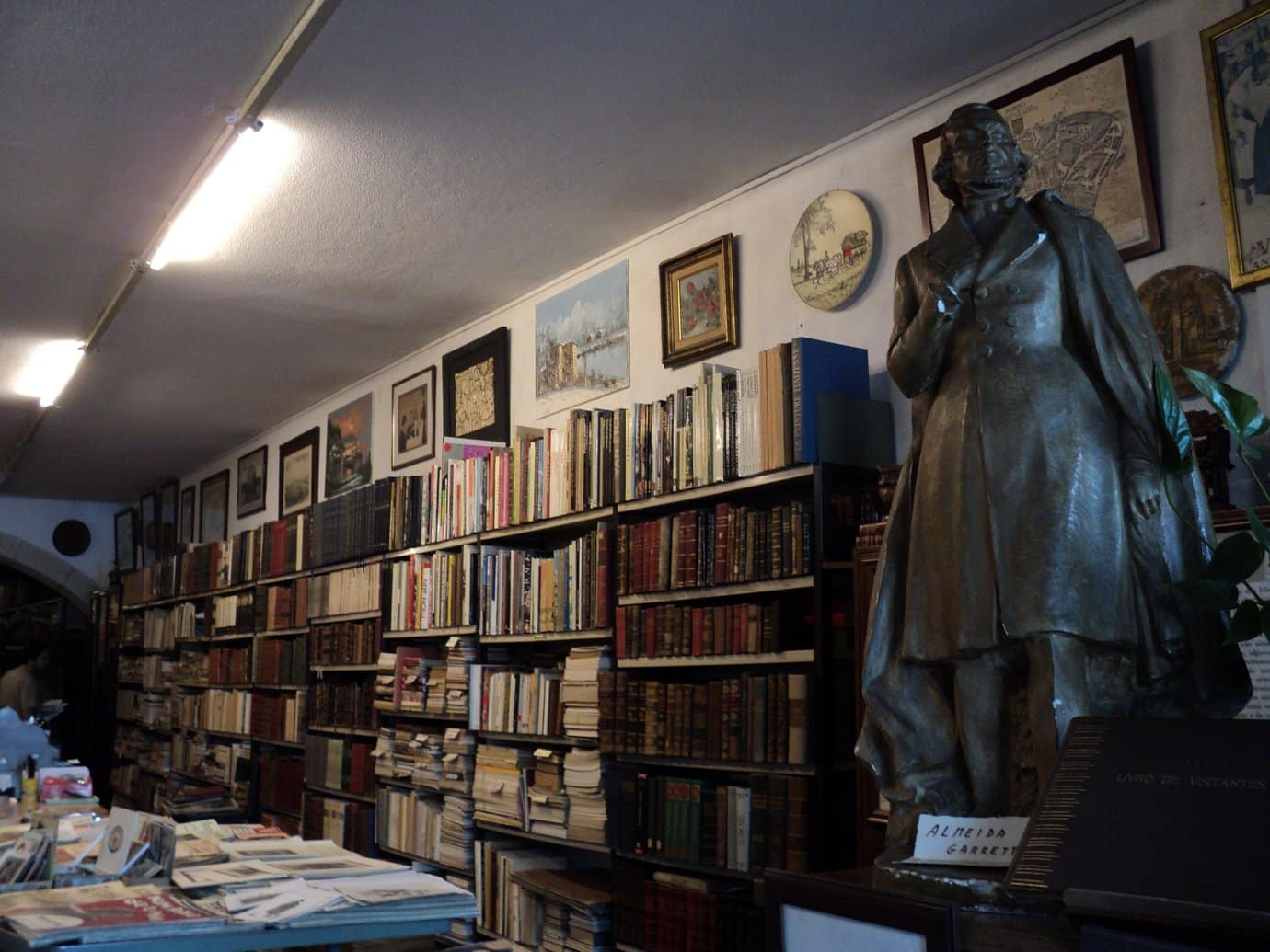
A few minutes from Lello on Rua das Flores sits Chaminé da Mota, a secondhand and antiquarian bookshop. It has traded here for over 40 years. It now holds close to a million books across four narrow floors. Gramophones, mechanical music boxes, typewriters, clocks and engravings fill whatever space the books leave behind. There is no grand staircase or stained glass here. Just a family business that has kept collecting rather than curating, and it shows.
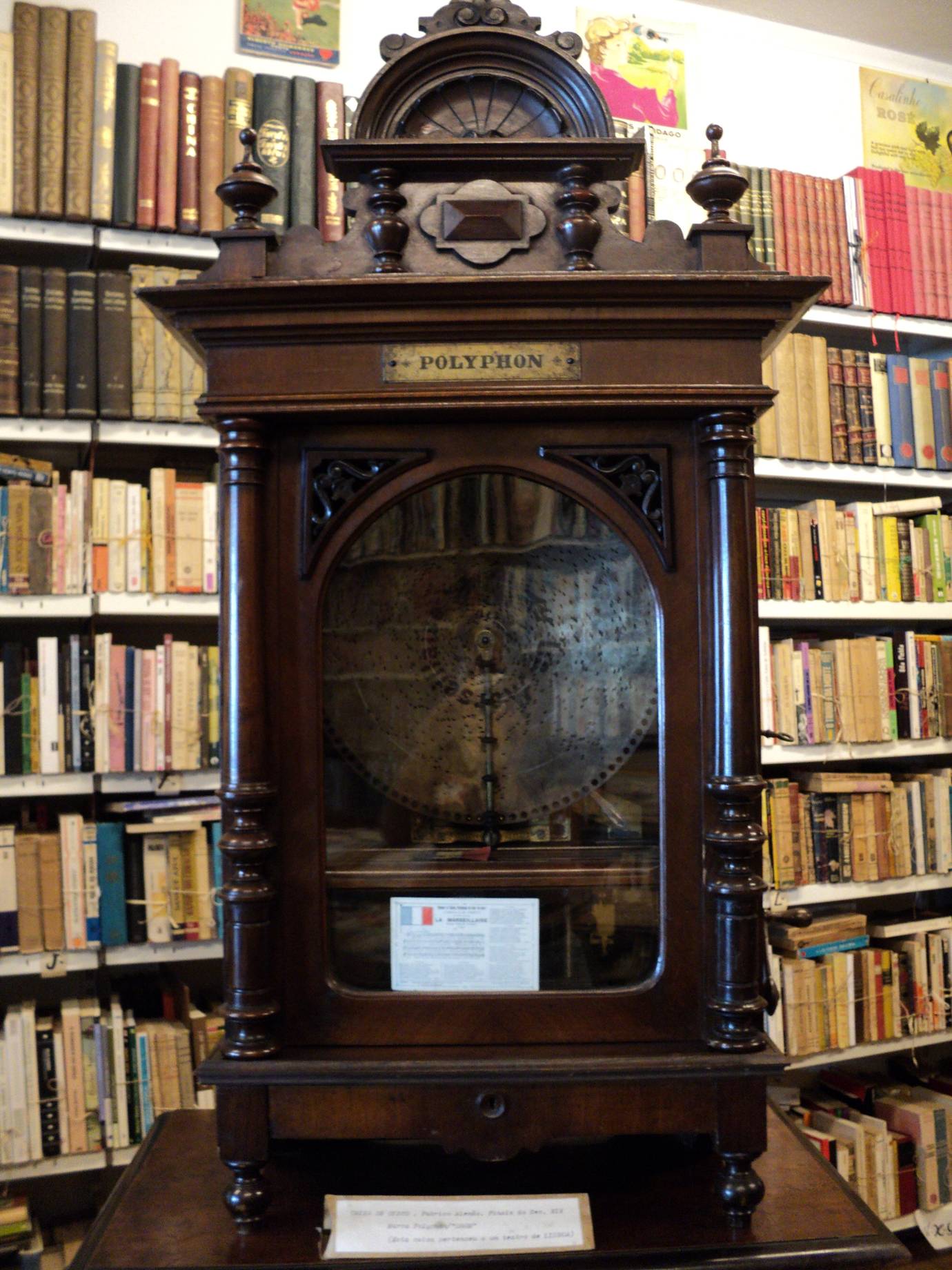
Among the antiques is a 19th-century Polyphon, a disc-driven mechanical music box that still sits among the shelves. It is closer in spirit to a music box than to the horn-speaker gramophones the shop is also known for stocking.
It rewards slow browsing over a quick visit. It is also the sharpest possible contrast to Lello’s polish. Two bookshops a few streets apart, both genuinely worth the stop, for opposite reasons.
Choosing the right Amiroad vehicle for a bookshop route
| Group Size | Recommended Vehicle | Best For |
|---|---|---|
| 1–3 passengers | Mercedes E Class / S Class | A relaxed Lisbon-to-Porto route with stops along the way |
| 4–6 passengers | Mercedes V-Class | Families splitting the day between bookshops and other stops |
| 8–15 passengers | Mercedes Sprinter (Van) | Small groups touring Lisbon, Coimbra and Porto together |
A couple pairing Lello with a Porto stay fits easily in a sedan. A small group stringing several of these stops into a longer trip gets more room to spread out. There’s also more space to bring purchases home in the V-Class.
Amiroad’s Services
A route built around bookshops is an easy one to fold into an existing itinerary. Amiroad’s Lisbon tours already pass through Chiado. Our Porto and Coimbra tour covers both historic centers in a single day, close to Lello and the Arco de Almedina. A private driver also means no need to plan around opening hours or timed tickets between stops. Every vehicle in Amiroad’s fleet has room for whatever ends up coming home in a bag.
Frequently asked questions
Is Livraria Bertrand really the oldest bookshop in the world?
Yes. Livraria Bertrand opened in 1732 in Lisbon. It was certified by Guinness World Records in 2011 as the oldest bookshop in the world still in operation.
Did J.K. Rowling really get inspired by Livraria Lello?
No. Rowling stated in 2020 that she never visited Livraria Lello and only learned of its existence after the fact. Despite the popular myth, the Harry Potter connection is unfounded, even though it remains a widely repeated story.
Do you need a ticket to visit Livraria Lello?
Yes, entry requires a timed ticket, and the cost is deducted from any book purchased inside. Booking ahead is recommended in high season.
What is special about Livraria Almedina in Coimbra?
It sits at the foot of the Arco de Almedina, Coimbra’s medieval city gate. It grew from a single shop opened in 1955 into Grupo Almedina, one of Portugal’s leading academic and legal publishers.
What is the flying bicycle at Ler Devagar?
A kinetic sculpture by Italian artist Pietro Proserpio, built from recycled materials, suspended above the main hall of this LX Factory bookshop in Lisbon.
Is Livraria de Santiago in Óbidos still an active church?
No. The Igreja de São Tiago was deconsecrated before being converted into a bookshop in 2013. Its 12th-century architecture, later rebuilt after the 1755 earthquake, remains fully intact.
Why is Óbidos called a Literary Village?
Óbidos joined UNESCO’s Creative Cities Network as a City of Literature in December 2015. The town has since opened eleven themed bookshops, including one inside a former church, part of the ongoing Óbidos Vila Literária project.
What is Déjà Lu in Cascais?
A secondhand charity bookshop on the first floor of the Citadel Art District, inside the Cidadela de Cascais. All profits support the employment of people with Trisomy 21.

For tailor-made tours or other programs, please get in touch with us through the telephone below or by filling out the form.