

Monsanto Portugal, a tiny enchanted village
Monsanto is a village in the municipality of Idanha-a-Nova, District of Castelo Branco, near the Spanish border. To the north lies the Serra da Estrela, a protected parkland. It is home to the highest point of mainland Portugal and to towns such as Seia, Covilhã, Manteigas and Guarda. Guarda is about 80 km from Monsanto by road, so the two combine well on a longer trip.
Typical, picturesque, Monsanto is frequently called the “most Portuguese village of Portugal”, especially because of its medieval special character. Few villages in Portugal look like this, with traditional houses sandwiched between gigantic boulders.
This village has a surprise around every corner. Houses built within huge boulders, and narrow streets up to the hilltop will take you to the fortress. Its privileged location, high up in the valley, made it once a great defense against the sieges.
Today, Monsanto is listed as one of the twelve Historic Villages of Portugal (Aldeias Históricas).
Monsanto at a glance
- Where: municipality of Idanha-a-Nova, district of Castelo Branco, in the Beira Baixa region and close to the Spanish border.
- Known for: granite boulder houses, a Templar castle and the 1938 title of “most Portuguese village in Portugal”.
- From Lisbon: about 275 to 280 km, roughly 3 hours by road.
- Time needed: at least half a day, ideally an overnight stay.
- Best seasons: spring and autumn.
- Mobility: steep granite lanes, and cars cannot enter the historic core.
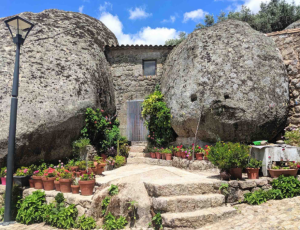
Why is Monsanto the “most Portuguese village in Portugal”?
The title dates from 1938. That year, a government-sponsored contest under the Estado Novo regime went looking for the most authentically Portuguese village, and Monsanto won. Its prize was the Galo de Prata (Silver Rooster). A replica of it now sits atop the village’s clock tower, the Torre de Lucano.
Take the label with a pinch of salt, since it began as a propaganda exercise. The setting, however, backs it up. According to the official Aldeias Históricas brochure, the village stands on a granite inselberg that rises to about 760 m. The brochure describes a meeting of two architectures: the natural chaos of the boulders and the almost cave-like homes people built around them. In 1995, Monsanto joined the Historic Villages network.
A Templar fortress on the border
The hilltop is the oldest part of Monsanto. After the reconquest, King Afonso Henriques entrusted the stronghold to the Knights Templar in 1165. They built the castle to guard the frontier, and the village received its charter in 1174. The settlement we see today grew down the slope from the 15th century onwards.
Much of the medieval castle was lost in the 19th century, when an accidental explosion in the gunpowder store destroyed part of it. The ruins remain dramatic. Legend adds a good story: during a siege, the defenders supposedly threw a calf over the walls to bluff the attackers, who then gave up.
But, what’s there to see in Monsanto?
You can choose a half-day or even a whole day trip, so you can explore the cobble streets and wonderful rock houses, some of them can actually look like they were built as one – the rocks and the houses.
Village hikes & landscape overlooking the countryside
Crossing all the granite-paved streets and hobbit-sized houses, walking trails from the bottom of the village to the hilltop, are always a good idea.
There are plenty of signs along the way to guide you through the most beautiful sights.
Along the way, you’ll see how Portuguese people who live here adapted their lifestyle by building homes under and between massive rocks. Something that you’ll find somehow funny, fascinating, and curious, all at the same time.

Visit Monsanto Castle
The castle crowns the highest point of the village, with views that run for miles across the plains towards Spain. One local guide says the horizon reaches as far as Cáceres on a clear day.
The climb is steep, so take your time. The lanes are uneven granite and can be slippery after rain. Wear sturdy shoes, bring water in summer and use the stone benches along the way. Visitor guides also note few safety barriers at the top, so watch your footing.
Inside the ruins, look for the remains of the keep, the cistern, the Porta da Traição (Traitor’s Gate) and the small Chapel of Santa Maria do Castelo. Just outside, the Romanesque ruins of the Chapel of São Miguel stand nearby. The lone arch of the Chapel of São João frames wide valley views. Recent visitor reports describe the ruins as open-air and free to enter. Even so, confirm access with the Monsanto tourist office on +351 277 314 642 before you go.
Village landmarks worth finding
Allow time to wander rather than rush. The official village map marks more than twenty stops, and a few stand out:
- Torre de Lucano: the clock tower, crowned with the Silver Rooster replica.
- Igreja Matriz de São Salvador and the Misericórdia church: two of the village’s main churches, the latter with Renaissance features.
- Casa de Uma Só Telha: a house squeezed under a single granite slab, best admired from outside.
- Fernando Namora’s house and former surgery: both are marked on the map, a nod to the doctor and writer who lived here.
- Chapel of São Pedro de Vir-à-Corça: an early 13th-century Romanesque chapel set in a striking landscape outside the village.
Fantasy fans may also recognise the setting. Monsanto served as a filming location for HBO’s House of the Dragon. A themed route called the Dragon’s Nest, opened at the end of 2023, leads up to the castle.
Festa da Divina Santa Cruz, marafonas and the adufe
If your dates allow, plan around early May. During the Festa da Divina Santa Cruz (around 3 May), participants throw symbolic clay pots filled with flowers from the castle walls. Meanwhile, women carry marafonas, rag dolls without eyes or mouths, to the tops of the towers. These dolls were traditionally made for the festival to protect homes from thunderstorms. The adufe, a percussion instrument played by women, is another living local tradition. For more celebrations across the country, see our guide to festivals and traditional festivities in Portugal.
Typical Portuguese cuisine at its higher quality and tradition
Monsanto’s kitchens draw on the cooking of the Beira Baixa. Expect hearty, honest plates: roast kid (cabrito assado), lamb stew (ensopado de borrego), rabbit rice, Iberian pork cheeks and red bean migas. Regional sheep’s cheese, chouriço and farinheira sausages often appear too. Bolo finto, a sweet bread, makes a fitting end to the meal.
Petiscos & Granito, with dining rooms set among the boulders, and Adega Típica O Cruzeiro are two names that recur in visitor guides. Opening days change with the season. Some places close early or serve only lunch, so call ahead, especially for dinner. For more on regional dishes, read our guide to Portuguese food.
Beyond the village: Idanha-a-Velha, Penha Garcia and the Naturtejo Geopark
Monsanto works well as the anchor for a longer day. Two of the area’s best stops lie within about 15 km.
Idanha-a-Velha: Roman Egitânia
Idanha-a-Velha, another Historic Village, is about 15 km from Monsanto. It stands on the site of the Roman city of Egitânia (Civitas Igaeditanorum). In the 6th century it became the seat of a bishopric. You can still see remains of the cathedral and its baptistery. A museum of Roman inscriptions occupies the grounds of an old olive press.
Penha Garcia: trilobite tracks and a river beach
Penha Garcia lies about 11 km away, inside the Naturtejo UNESCO Global Geopark. Its Ichnological Park preserves trace fossils left by trilobites around 480 million years ago, when a shallow sea covered the area. The best-known traces are called Cruziana.
The Fossil Route (PR3 IDN) is a loop of roughly 2.7 to 3 km along the Ponsul river gorge. Allow about an hour. The difficulty is average, and the ground can be rocky. Entry is free, with no fixed opening hours. Guided visits by Naturtejo specialists must be booked in advance. In summer, the village’s river beach offers a cooling swim afterwards.
Monsanto and the Geopark
Monsanto itself belongs to the same territory. The official brochure lists the village’s granite hill as one of the geomonuments of the Naturtejo Geopark, under UNESCO auspices. Seen this way, the boulders are more than scenery: they tell the story of the Earth.
Is Monsanto accessible for visitors with reduced mobility?
Only partly. The village sits on a steep hillside, and the lanes are uneven granite that turns slippery when wet. Cars cannot enter the historic core. You park at the lower edge, then walk about 10 to 15 minutes uphill to the main square. The castle climb is demanding and may not suit everyone.
On the positive side, the official brochure includes an accessible-route map with gradient colour codes, which helps with planning. If anyone in your group has limited mobility, tell us when you book, and we will plan the stops around that. Our tips for travelling in Portugal with elderly parents may also help.
When is the best time to visit Monsanto?
Spring and autumn are ideal, with milder weather and fewer visitors. Summer is hot, with little shade. Visit in the morning, then cool off at a river beach such as Penha Garcia’s. Winter is quieter and more atmospheric, although cooler and wetter. Whatever the season, late afternoon and sunrise give the castle its best light. For wider planning, see the best time to visit Portugal.
How to get to Monsanto?
This one is on us!
Monsanto sits off the main tourist routes, so public transport is limited and driving is by far the easiest option. Approximate road distances and times:
- Lisbon: about 275 to 280 km, around 3 hours, via the A1 and A23, then national roads.
- Porto: about 295 km, roughly 3 hours, via the A1 and A25 towards Penamacor.
- Coimbra: about 2 hours 15 minutes.
- Castelo Branco: about 50 km, under an hour.
- Guarda, the gateway to the Serra da Estrela: about 80 km, around 1 hour 20 minutes.
These are estimates, so allow extra time for stops. A private driver takes the stress out of narrow roads, parking and navigation. With Amiroad Luxury Transports, you travel in comfort, and your driver can shape the day around you: Monsanto first, then Idanha-a-Velha and Penha Garcia, or an overnight stay before continuing towards the Serra da Estrela. If you are weighing options, compare private transfers and car rental. For a shorter outing, browse our private day trips from Lisbon.
Monsanto also fits neatly on a road trip between the Alentejo and the Serra da Estrela. In winter, snow in the mountains adds a different mood. Close to the border, it is an easy stop on private transfers between Portugal and Spain too. For a fully tailored itinerary, see our guided tours with a chauffeur.
Also, our Luxury fleet and driver will provide you with an experience to remember.
Frequently asked questions
Why is Monsanto called the most Portuguese village in Portugal?
Monsanto won that title in a government-sponsored contest in 1938, under the Estado Novo regime. The village’s houses, built between and under giant granite boulders, helped it stand out. The prize was a Silver Rooster, and a replica now tops the village’s clock tower.
How far is Monsanto from Lisbon?
Monsanto is about 275 to 280 km from Lisbon, which means roughly 3 hours by road. Most drivers take the A1 and A23 motorways, then national roads. Public transport is limited, so a private driver or a car is the practical choice.
How long do you need in Monsanto?
Allow at least half a day to walk the village and climb to the castle. An overnight stay is even better, because the village feels calmer after the day visitors leave. Add Idanha-a-Velha or Penha Garcia, both within about 15 km, if you have a full day.
Can you drive into Monsanto’s historic centre?
No, cars cannot enter the historic core. You park at the lower edge of the village and walk about 10 to 15 minutes uphill. The lanes are steep, uneven granite, so wear sturdy shoes.
When is the best time to visit Monsanto?
Spring and autumn are best, with mild weather and fewer visitors. Early May adds the Festa da Divina Santa Cruz. Summer is hot with little shade, so go early in the day. For official information on the village and its events, see the Aldeias Históricas page for Monsanto and the Idanha-a-Nova municipality.

For tailor-made tours or other programs, please get in touch with us by telephone or by filling out the form below.