
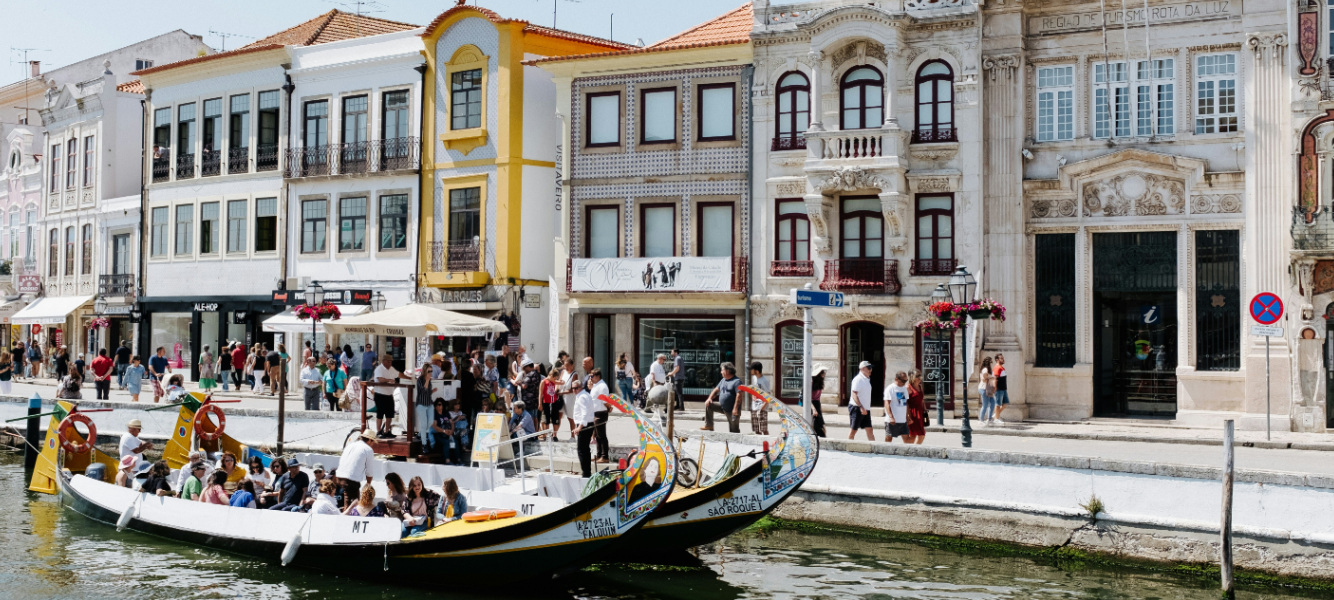
Aveiro, Portugal: The Insider’s Guide to the “Venice of Portugal”
Aveiro sits on the western coast of Portugal, wedged between the Aveiro Lagoon and the Atlantic Ocean, in the Centro Region. Most travel guides stop at “colorful boats and canals.” What they tend to leave out is that Aveiro rewards visitors who go one layer deeper: a train station with a buried court scandal painted into its tiles, a porcelain factory that built an entire village for its workers, and a salt industry that has shaped the local economy since Roman times and still operates today.
This guide goes beyond the highlight reel. It covers what to actually expect from a Moliceiro ride, what it costs, which lesser-known stops are worth the detour, and how to structure a visit so it doesn’t feel like a rushed checklist.
Quick facts about Aveiro
| Information | Detail |
|---|---|
| Region | Centro Region, Aveiro District |
| Distance from Porto | Approximately 70 km, around 45 to 60 minutes by car or train |
| Distance from Lisbon | Approximately 250 km, around 2 hours 30 minutes by car, 2 to 2h10 by train |
| Best time to visit the city | April, May, September, October, for fewer crowds and pleasant weather |
| Best time for Costa Nova beaches | June to August |
| Recommended time on site | Half a day for the historic center, a full day with Costa Nova or Ílhavo added |
| Known for | Canals, Moliceiro boats, art nouveau architecture, ovos moles, Vista Alegre porcelain |
How to get to Aveiro
Aveiro sits directly on the Lisbon-Porto railway line, which makes it one of the easiest cities in the country to reach without a car. From Porto’s São Bento or Campanhã stations, the urban and intercity trains take roughly 45 to 60 minutes. From Lisbon’s Santa Apolónia or Oriente stations, the journey runs about 2 to 2h10 on the faster Alfa Pendular service. By road, Aveiro sits just off the A1 motorway.
One detail that catches first-time visitors off guard: ride-hailing apps like Uber or Bolt between Porto and Aveiro typically start around 50 euros one way and climb fast with demand, especially on summer weekend evenings when everyone is heading back from Costa Nova at the same time. For a comfortable, fixed-price alternative that doesn’t depend on surge pricing or train timetables, a private transfer removes that uncertainty entirely. Amiroad Luxury Transports offers private tours from Porto that can be tailored to include Aveiro, along with custom day trips departing from other regions of the country.
A brief history of Aveiro
Aveiro’s history predates the Roman era, when the area was known as “Aviarium,” named for the abundance of birds in the surrounding lagoons. Under Roman rule, the region became an important center for salt production, a trade that would go on to define the local economy for nearly two thousand years. By the Middle Ages, Aveiro had grown into a significant trading hub, and salt remains visible in the landscape today through the salt pans that still partially operate around the lagoon.
For centuries, Aveiro’s fortunes were tied directly to the lagoon. In 1575, a violent storm sealed the natural channel connecting the lagoon to the sea, cutting off the city’s access to open water and triggering a long economic decline marked by flooding and disease. It wasn’t until 1808 that engineers successfully reopened a permanent channel, the Barra Nova, restoring the lagoon’s connection to the Atlantic and setting the stage for Aveiro’s 19th-century revival as a trading and fishing port.
What to do in Aveiro
Ride a Moliceiro through the canals
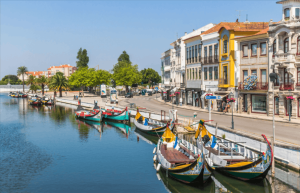
The Moliceiros are the most recognizable symbol of Aveiro. These flat-bottomed boats, hand-painted with colorful folk scenes, were originally used to harvest moliço, a type of seaweed once gathered as fertilizer for the region’s farmland. Today they carry tourists instead.
Here’s what to actually expect: tours run roughly every 45 minutes, last about 45 minutes to an hour, and cost between 10 and 17 euros per adult depending on the operator, with discounted rates for children. Boats depart frequently from kiosks along the Canal Central, near the Rossio Garden, and most hold 15 to 32 passengers. During peak season, June through September, walk-up tickets are usually available even with a short wait, but booking online in advance guarantees a specific departure time and avoids any uncertainty. The early morning, before 11am, and late afternoon, after 4pm, offer calmer water, softer light for photos, and noticeably fewer crowds than midday.
A detail most visitors miss: tours typically pass through four main waterways, the Canal Grande, Canal de São Roque, Canal do Cojo, and Canal das Pirâmides, each with a different character, from the grand art nouveau facades of the central canal to the quieter, more residential stretches further out.
Walk through Aveiro’s art nouveau district
Aveiro has one of the best-preserved collections of art nouveau buildings in Portugal, concentrated mainly around the central canal. Several of these facades have been carefully restored and now house cafés, small museums, and shops, which makes a slow walking loop through the center worthwhile even between boat departures.
See the controversy hiding in the old train station’s tiles
The Estação Velha, Aveiro’s original 1916 train station building, is covered in roughly 50 panels of blue, yellow, and white azulejo tiles depicting scenes from the city’s history, culture, and daily life, including fishermen working the lagoon and views of the Rio Vouga. It’s easy to walk past it as a pretty photo stop. What most visitors don’t know is that the tiles caused a genuine local scandal when they were unveiled. The railway company had originally planned to honor two historical figures side by side in tile, José Estevão and Manuel Firmino, both linked to the station’s construction. A dispute between the two men’s families and supporters escalated into a court case, and in the end only Manuel Firmino’s panel made it onto the wall.
The historic building sits right next to the modern station, so to see the full tile facade, exit through the new terminal and walk around to the older structure rather than expecting to find it from the platforms.
Visit the Vista Alegre porcelain factory and museum, in nearby Ílhavo
About 15 to 20 minutes from central Aveiro, in the town of Ílhavo, sits Vista Alegre, one of the most prestigious porcelain manufacturers in Europe, founded in 1824. This is the kind of stop that rarely makes it onto generic Aveiro itineraries, despite being one of the most interesting half-day additions in the region.
The factory’s founder built an entire self-contained village around the production site, complete with a chapel, school, theater, and housing for workers, since the location was originally too remote from any existing town. Visitors can tour the museum’s five galleries tracing nearly two centuries of porcelain production, watch hand-painting artists at work in the manufacturing area, see the 17th-century baroque chapel, and browse an outlet store with noticeably better prices than the main shop. Plan for three to four hours if visiting the museum, chapel, and outlet in full. Some visitors find the 30-minute guided tour rushed; arriving early and asking about a quieter, more in-depth visit window tends to pay off.
Day trip to Costa Nova and Praia da Barra
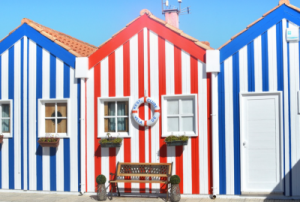
Around 10 kilometers from the city center, Costa Nova is known for its striped wooden beach houses, originally built by local fishermen using leftover boat materials and now one of the most photographed spots in the region. Praia da Barra, nearby, is home to one of the tallest lighthouses in Portugal and draws a steady crowd of surfers thanks to consistent Atlantic swell. Both beaches sit close enough to the city to combine naturally with a half-day canal visit, especially with private transport that skips the bus connections.
Walk or cycle the salt pans
The salinas surrounding the lagoon are still partly active, producing a distinctive landscape of white salt mounds reflecting against the water. Several local operators run guided walks explaining the traditional harvesting process, a trade that has shaped this exact stretch of coastline since the Roman occupation nearly two thousand years ago.
What to eat in Aveiro
| Dish | Description |
|---|---|
| Ovos moles | Sweet egg yolk filling wrapped in a thin wafer shell, holds Protected Geographical Indication status |
| Caldeirada de enguias | Traditional eel stew, a regional specialty tied to the lagoon’s ecosystem |
| Bacalhau à Brás | Shredded codfish with potatoes, eggs, and onions, found across Portugal but especially good here |
| Fresh lagoon seafood | Clams, eel, and other lagoon catches feature heavily on local menus |

Ovos moles deserve a closer look. The filling, made from egg yolks and sugar syrup, is either eaten loose or wrapped in a thin wafer shell, traditionally molded into shapes tied to the city’s maritime identity: shells, fish, barrels. The recipe is believed to trace back to local convents, where nuns produced sweets using egg yolks left over after using the whites to starch religious habits, a practice common across several Portuguese monastic sweets. The dessert is so closely tied to the region that it holds Protected Geographical Indication status from the European Union, meaning only confections made in the Aveiro area following traditional methods can legally carry the name. A Barrica, one of the city’s oldest confectioneries, is frequently mentioned by locals as one of the most traditional spots to try them, often paired with the end of a Moliceiro tour.
Festivals and local traditions
Aveiro’s calendar includes two events that draw visitors well beyond the region. The Festa de São Gonçalinho, held every January, sees locals climb the chapel roof to throw cavacas, hard sugar-coated cakes, down to the waiting crowd, in honor of the city’s patron saint. Later in the year, the Festival do Bacalhau celebrates the region’s historic ties to codfish fishing with culinary competitions, concerts, and cultural events.
Local life and atmosphere
Aveiro’s residents, known as Aveirenses, maintain close ties to the city’s maritime past and a strong sense of community. The Mercado do Peixe, the city’s fish market, remains a central part of daily life, supplying fresh seafood to the many restaurants lining the canals. The city’s cafés and pastelarias function as informal meeting points, where a bica, the local term for an espresso, is typically served alongside a pastel de nata or a box of ovos moles.
Aveiro vs. other day trips from Porto and Lisbon
| Destination | Distance from Porto | Distance from Lisbon | Best known for |
|---|---|---|---|
| Aveiro | 45-60 min | 2h-2h30 | Canals, Moliceiros, beach houses, porcelain |
| Coimbra | 1h | 2h | University, Joanina Library |
| Braga | 1h | 3h30 | Religious architecture, Bom Jesus |
| Sintra | 3h | 30 min | Palaces, gardens |
Aveiro pairs particularly well with Coimbra, since both sit along the same train line and motorway route between Lisbon and Porto, making it possible to combine the two cities in a single day with the right transport arrangement. Many private tours from Porto bundle the two together for exactly this reason.
How long to spend in Aveiro
A focused visit covering the historic center, a Moliceiro ride, and lunch fits comfortably into half a day. Adding Costa Nova or Vista Alegre stretches the visit to a full day. Travelers combining Aveiro with Coimbra, or building it into a wider Porto-to-Lisbon itinerary, generally find that a private tour is the most efficient way to fit everything in without working around train schedules or hunting for parking near the canal.
Plan your visit to Aveiro with Amiroad
Amiroad Luxury Transports arranges private tours and transfers to Aveiro from Porto, Lisbon, and other regions of the country, with professional drivers and a premium fleet built for comfort on longer journeys. Whether the plan is a focused half-day visit or a combined route through the Centro Region that includes Costa Nova, Ílhavo, or Coimbra, our team can build the itinerary around it.
Looking for a private tour to Aveiro? Get in touch and we will help plan the trip.

For tailor-made tours or other programs, please get in touch with us through the telephone below or by filling out the form.